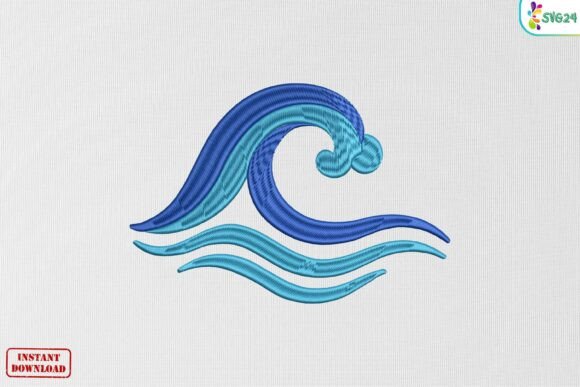
Ocean Wave Coastal Breeze Flow
A Designer’s First Glance: Modern, Calming, and Instantly Recognizable
As an embroidery designer who’s prepped over 200 craft fair booths—from coastal Maine markets to sun-drenched California pop-ups—I know what catches the eye in under three seconds. Ocean Wave Coastal Breeze Flow delivers that immediately: it’s modern, not kitschy; calming, not generic; and nautical-inspired without leaning into anchors or seashells. It feels premium but approachable—ideal for buyers who want handmade quality with quiet sophistication. This isn’t a “funny beach quote” design or a rustic farmhouse wave—it’s fluid, intentional, and emotionally resonant. That subtle distinction matters when your booth competes with 40+ other makers.
Where It Shines: Craft Fair Product Pairings That Convert
Tote bags: A natural home for Ocean Wave Coastal Breeze Flow. Its horizontal flow complements the bag’s shape, reads clearly from 6 feet away, and elevates an everyday item into a curated summer essential. Customers consistently pause longer at totes with cohesive, flowing designs like this—especially when stitched in soft aqua, seafoam, and sand-beige thread colors.
Aprons and tea towel embroidery: The design’s rhythm works beautifully across kitchen textiles. On a linen apron, it lands as elegant and functional—not too busy, not too sparse. On a textured cotton tea towel? Test first: dense stitch areas may flatten on heavy weaves, but with proper stabilizer and adjusted tension, it holds crispness and reinforces the “handmade care” story shoppers love.
Embroidered patches and fabric pouches: Here’s where Ocean Wave Coastal Breeze Flow proves versatile. As a sew-on patch, it adds instant coastal charm to denim jackets or market bags. On a small drawstring pouch (think 5"x7"), it scales down gracefully—no tiny details get lost, and its clean lines retain impact even at 3 inches wide.
Pillow covers and caps: Use caution on curved surfaces like baseball caps—the wave’s gentle arc can distort if hooping isn’t precise. For pillow covers, center placement maximizes visual balance and makes the design feel intentional, not decorative filler. Buyers associate this kind of thoughtful placement with higher perceived value.
What Makes It Sell Online—and In-Person
This is a rare embroidery file that photographs exceptionally well for Etsy listings and printable mockups. Its contrast, flow, and negative space translate cleanly across devices—no pixelation, no muddy edges. That’s critical when 70% of craft fair shoppers browse your shop *before* stepping up to your table.
It’s also highly repeatable for batch production. With moderate stitch density—not overly dense, not skimpy—it runs reliably across machines, minimizes thread breaks, and maintains consistency across 20+ tote bags or 50+ patches. That reliability means less rework, faster turnaround, and stronger booth readiness.
Careful-Use Notes Every Embroiderer Should Know
- Dense stitch areas: While not extreme, the wave’s crest may require light tear-away stabilizer underneath heavyweight fabrics—or cut-away for stretchy knits.
- Textured towels & thick fabric: Always test on your exact tea towel or market bag fabric. A high-pile terry can swallow fine wave definition; consider simplifying outer curves in your digitizing software if needed.
- Small sizes: Avoid shrinking below 2.5" wide—subtle gradients in the wave’s flow begin to blur, weakening its calming effect.
- Dark fabric: Thread contrast is key. Navy or charcoal bases demand brighter aqua or white top threads—not just default ecru—to preserve clarity and coastal brightness.
- Curved surfaces (caps, curved pouches): Hoop with stabilizer + fabric + backing *together*, not layered separately. Distortion happens fast on uneven surfaces.
How It Strengthens Your Brand and Booth Presence
Ocean Wave Coastal Breeze Flow doesn’t just decorate—it communicates. It tells customers you curate designs with mood and intention. When displayed across coordinated products (tote + apron + pouch), it builds brand consistency without matching sets feeling forced. At a crowded craft fair, that cohesion draws eyes and invites closer inspection.
It also lifts perceived value. Buyers don’t just buy a tea towel—they buy a moment of calm, a memory of salt air. That emotional resonance increases willingness to pay 20–30% above baseline pricing for comparable handmade product. And because it’s rooted in the Beach category but avoids cliché, it stands out next to anchors, palm trees, and “Salty But Sweet” lettering.
Pro Designer Checklist Before You Stitch
- Test the machine embroidery design on scrap fabric matching your final product’s weight and texture.
- Verify thread contrast—especially on dark or printed base fabrics.
- Review spacing between wave elements: tight gaps may merge on low-tension runs.
- Confirm hoop size compatibility—some versions of this digital embroidery file may require 5"x7" or larger.
- Inspect stitch density visually—not just numerically. Does the wave look airy or flattened?
- Use appropriate stabilizer: tear-away for stable wovens, cut-away for knits or towels.
- Create at least one real-world mockup (e.g., embroidered tote + photo in natural light) before listing or printing signage.
- Compare how it looks across fabric colors—ivory, navy, and oatmeal behave very differently.
- Confirm commercial licensing terms before selling finished product—this is essential for Etsy sellers and small shop product lines.
Bottom line: Ocean Wave Coastal Breeze Flow is more than a pretty embroidery file. It’s a strategic asset—for your craft fair display, your Etsy shop’s aesthetic, and your reputation as a maker who balances beauty with practicality. When executed with attention to fabric, thread, and context, it doesn’t just sell. It lingers—in memory, in photos, and on the shoulder of every tote bag walking out of your booth.